

Apollo to Orion: Exploring the Rockets and Astronauts Shaping Our Future

A rocket carries spacecraft from Earth’s surface to space, usually to low-Earth orbit or beyond. It is also known as a launch vehicle. In appearance, rockets are similar to one another, however, no two rockets are the same. They are complex devices with millions of pieces and systems working together. After every mission, mistakes are recognized and progressively fixed based on a spacecraft’s mission requirements.
Every journey outside the Earth’s atmosphere begins with a rocket. They continuously overcome Earth’s gravity to make space exploration possible. For many years, engineers have been developing different kinds of rockets, depending on each of the mission objectives. Today, space exploration missions are geared towards the final goal of the first humans reaching Mars. In order to achieve this goal, technological advanced rockets and courageous astronauts are required.
Rockets have many purposes beyond sending spacecraft and astronauts to space. Some of these purposes are:
Launching satellites providing services such as the GPS, weather forecasting and communications
Conducting scientific research
Monitoring Earth’s climate and environment
Many times, developing technologies for rockets requires the invention of new equipment that benefits daily life on Earth. For instance, memory foam, LED’s, thermometers, and portable computers are all examples of technologies used everyday, but were originally created for space travel.
Different Types of Rockets
The main types of rockets include solid, liquid and hybrid rockets. The main difference between these rockets is the physical states of their propellants, which is the chemical reaction ejected from an engine to produce thrust required to launch a rocket.
Solid Rockets
These kinds of rockets use a solid propellant. This means that a fuel and oxidizer mix together into a solid substance. The ignitor will burn the propellant, which then leads to the nozzle expelling hot gas, and thus creating thrust.
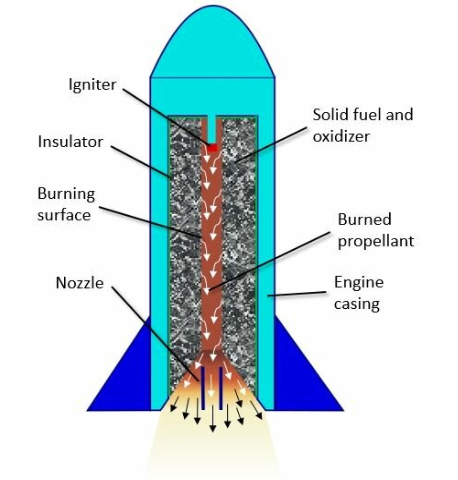
A big advantage of this rocket type is its simplicity. They only contain a few moving parts. When there are fewer moving parts, there is a lower chance of a leak, or degradation allowing long-term storage. However, once they are ignited, it is harder for a complete engine shut down or movement.
Examples of Solid Rockets:
Model Rockets - small, educational and recreational rockets
Sounding Rockets - perfect for short scientific missions and to reach Earth’s upper atmosphere
Solid Rocket Boosters (SRB’s) - provide powerful thrust during early launch stages - designed more for the heavier payloads
If you want to learn more about solid rockets, check out this link: https://www.grc.nasa.gov/www/k-12/rocket/TRCRocket/practical_rocketry.html
Liquid Rockets
On the other hand, liquid rockets store their fuel and oxidizer in separate tanks in liquid form. Both liquids are pumped into the combustion chamber where they react and generate thrust.

In comparison to solid rockets, liquid rockets can change direction easily, shut down, and/or restart. This provides a greater amount of control and accuracy to mission control. This also means that its system is more complex and requires sophisticated tinkering, making it more expensive.
Examples of Liquid Rockets:
Single Stage Rockets - one propulsion stage throughout rocket (perfect for smaller launches and/or experiments)
Multi-Stage Launch Vehicles - multiple rocket stages separable during flight allowing a higher altitude to be reached
Crewed Launch Systems - for sending astronauts to space
If you want to learn more about liquid rockets, check out this link: https://www.grc.nasa.gov/www/k-12/airplane/lrockth.html
Hybrid Rockets
Combining elements from solid and liquid rockets results in a hybrid rocket. Normally, they use solid fuel and a liquid oxidizer.
An advantage of these kinds of rockets is that you can use the advantages of both solid and liquid rockets. For instance, the simplicity of a solid rocket along with the efficiency and control of liquid rockets can be combined into one rocket.
Examples of Hybrid Rockets:
Experimental - used by researchers and universities for testing
Commercial Suborbital Hybrids - used for short duration spaceflights and tourism
If you want to learn more about hybrid rockets, check out this link: https://firehawkdefense.com/propulsion-energetics-technology/hybrid-rocket-engine/

These rocket types are used in different mission types. Some of the most famous space missions throughout history that utilize hybrid rockets include:
Apollo 11 (1969) landed the first humans on the Moon, making Neil Armstrong and Buzz Aldrin the first humans to walk on the Moon
Sputnik 1 (1957) was the first artificial satellite launched by the Soviet Union and marked the start of the space age
Voyager 1 (1977) is a spacecraft that explored the solar system’s outer planets and became the first human-made object to enter interstellar space
In November of 2026, Voyager 1 will have travelled one light day!
Mars Rover Missions involves rovers like Curiosity and Perseverance, which help our understanding of Mars and its potential to support life
Artemis II (2026) is a mission involving the life support systems on Orion. This was the first mission back to the Moon in more than 50 years, and was the first time humans saw the Dark Side of the Moon
Final Notes
From launching satellites into Earth’s orbit to sending humans to space, rockets have been at the start of some of humanity’s greatest achievements. Despite common solid, liquid, or hybrid powering methods, each rocket serves a unique purpose and contributes to our ability to explore the universe.
As we look into the future, spacecraft innovation is at a height for new discoveries, lunar exploration, and an eventual mission to Mars. While rockets are very different from one another, they all share the same goal: helping humanity reach further and continue our journey through the stars.
Written By: Krisha L
Sources
Ryan Patrick (July 24, 2024). Types of Rockets. https://ryanmpatrickauthor.com/2024/07/24/types-of-rockets/
NASA (n.d). Spaceships and Rockets. https://www.nasa.gov/humans-in-space/spaceships-and-rockets/
Britannica (n.d). Propellent. https://www.britannica.com/science/propellant
NASA (n.d). Apollo 11. https://www.nasa.gov/mission/apollo-11/
Images
Mike Wall (April 29, 2025). New Record! 6 rockets launch in less than 24 hours. https://www.space.com/space-exploration/launches-spacecraft/new-record-6-rockets-launch-in-less-than-24-hours
Ryan Patrick (July 24, 2024). Types of Rockets. https://ryanmpatrickauthor.com/2024/07/24/types-of-rockets/


Comments