

Stars: All About the Universe’s Shining Lights
When looking up at the night sky, we see bright, shining lights called stars. They may look small, but they are some of the most powerful objects in the universe. Stars are defined as massive balls made of mostly hydrogen and helium. Deep in space, they produce light and heat through a process called nuclear fusion. Inside the core of the star, hydrogen atoms combine to form helium – this releases a large amount of energy, which travels outward and shines up as light and heat.
Without stars, the universe would be an endless dark abyss where no galaxies, planets, or life could form. In fact, our sun is a medium-sized star, and the energy produced makes it possible for life on Earth to exist.
Here are some of the reasons why the Sun is required for life on Earth.
With the help of the Sun:
Plants can create their own food (using photosynthesis - light making process)
This food produces sugars to the global food chain
Liquid water stays in a livable range
Solar panels use the Sun to provide electricity
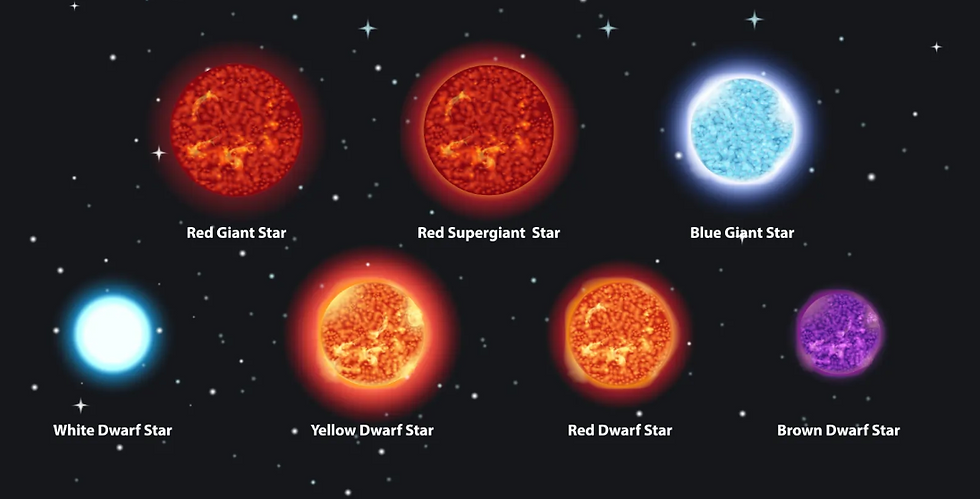
There are lots of different types of stars. They may vary in size, temperature, colour, and/or brightness.
Blue Stars: hottest stars in the universe
Burn their fuel very quickly and have shorter lifespans
Red Stars: cooler and often smaller
Sometimes called red dwarfs
Can survive for billions of years
Yellow Stars: medium-sized with moderate temperatures
Our sun is an example of a yellow star
Giant and Supergiant Stars: hundreds of times larger than the Sun
Life Cycle of Stars
Stars begin their life in giant clouds of gas and dust called nebulae. These clouds drift through space for millions of years. At a point, a dense clump of gas and dust is formed due to gravity. Pressure and temperature increase as the clump grows in size. When the core becomes hot enough, nuclear fusion begins, giving birth to a new star. As time passes, the fusion starts to become stable, and the star enters its longest stage (the “main sequence” stage).
The fate of a star depends entirely on one thing: its mass. Smaller stars live long and quiet lives, while massive stars live short and violent lives. As time passes, stars discard the hydrogen fuel inside them. Without enough fuel, the star becomes imbalanced, causing the outer layers to expand dramatically. This transforms the star into a giant.

Small or medium-sized stars turn into red dwarfs: they shed outer layers and leave behind a dense core called a white dwarf. On the other hand, if the stars are massive, they explode in giant explosions called supernovae; these are some of the biggest explosions in the universe. They generate a large flash of radiation, as well as shock waves similar to sonic booms. Most supernovae explosions occur so far from Earth that it is not impacted at all. They appear as bright spots in the sky. However, if an explosion were to occur near Earth, the impact could be detrimental. It could damage Earth’s atmosphere due to the intense amount of radiation. Atmospheric damage could cause a change in the climate. Although evidence is being studied, some scientists believe that previous mass extinctions, and climate changes have occurred due to supernovae explosions. After the supernovae, the remaining cores become neutron stars, or black holes.
Interesting Facts About Stars
Relationships between Elements and Stars
Many of the elements found in our universe are formed inside of stars. When the universe first began, only the simplest elements existed, such as hydrogen and helium. Inside the stars, fusion created the heavier elements such as carbon, oxygen, and iron.
During supernovae explosions, these elements spread across space and become a part of new stars, planets, and living things. This means that all the atoms in our bodies were formed inside ancient stars.

Looking into the Past
When we look at stars, we are actually seeing them as they were in the past because light takes time to travel through space. Space is so huge that even something as fast as light needs time to travel across it.
A light year is the distance that light travels in one year.
Examples include the Sun, which is eight light minutes away, so we see it as we see it as it looked eight minutes ago. Similarly, if a star is 100 light years away is seen as it looked 100 years ago.
When looking into the night sky, we are seeing different stars showing different moments in history. For example, if someone was on an alien planet 100 light years away from Earth, they would see Earth as it was 100 years ago. Some of these stars may not exist, however their light is still travelling toward Earth, so we are able to see them.
Formation of Constellations
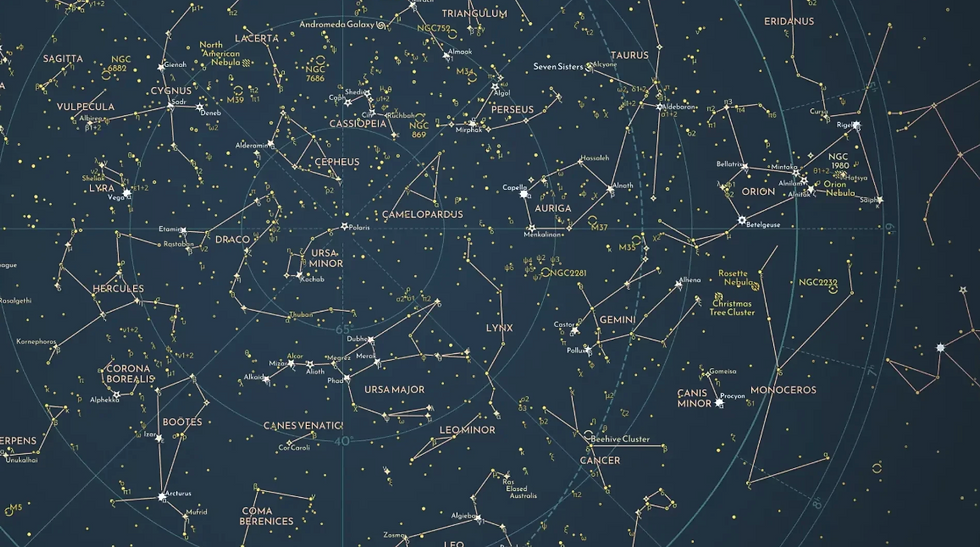
Many people think that constellations are formed in the night sky, and scientists are discoverers. However, it is the opposite; scientists recognize set areas of the night sky (these are not actually patterns in the sky). Today, there are 88 officially recognized constellations.
Constellations are distinct portions of our sky with precise borders, not simply a collection of stars near each other as we see them. It’s basically a map, but for the sky.
Why Stars Matter?
Rather than thinking of stars as bright lights, think about them as celestial objects shaping galaxies, creating planets, influencing gravity, and revealing the history of the cosmos. Astronomers can determine the formation of the universe, its changes, and possible life outside the Milky Way.
Some people believe that stars also influence human emotions. People have been searching for meaning, direction, and wonder. The night sky reminds us of our connection to something far greater than ourselves.
Famous Stars in the Night Sky
Some of the stars in the sky are very easy to spot as they are very bright. Some examples include:
Sirius - the brightest visible star from Earth
Polaris (the North Star)
Betelgeuse - a huge red supergiant in Orion (a type of constellation)
Rigel - the brightest blue star
Stars have unique characteristics that help astronomers study space and the universe.
Final Notes
In conclusion, stars are some of the most important celestial bodies in the universe. Stars are not just decorations in the sky; they tell the story of the universe and its past. Every night, we get the opportunity to look up at the night sky and see history being preserved in motion. We see the reason for the existence of humans. We are learning about the universe that has been developing for billions of years before humanity was even born!
Written By: Krisha L
Sources
NASA (n.d). Stars Basics. https://science.nasa.gov/universe/stars/
Space.com (Sep 26, 2022). Stars. Facts about stellar formation, history, and classification. https://www.space.com/57-stars-formation-classification-and-constellations.html
Britannica (May 15, 2026). Star. https://www.britannica.com/science/star-astronomy
ScienceFacts.net (n.d). Life Cycle of a Star. https://www.sciencefacts.net/life-cycle-of-a-star.html
US National Science Foundation - NSF (Feb 7, 2021). The stars within us. https://www.nsf.gov/science-matters/stars-within-us
Evan Gough (June 12, 2025). Supernova Explosions Changed Earth’s Climate and Shaped Humanity’s History. https://www.universetoday.com/articles/supernova-explosions-changed-earths-climate-and-shaped-humanitys-history
Images
Time for Kids (Feb 9, 2021). All About Stars. https://www.timeforkids.com/k1/all-about-stars/
Teide By Night (n.d). Types of Stars: A Stargazing Guide from Tenerife. https://www.teidebynight.com/types-of-stars-a-stargazing-guide-from-tenerife/
KiwiCo (Jan 15, 2023). A Star is Born: The Six Stages of a Star’s Life Cycle. https://www.kiwico.com/blog/the-science-behind/stages-of-a-stars-life-cycle?srsltid=AfmBOoqgwlg_7VbTymd92qCnDtfQ_sKTzTEEIm3HwnAAhVYDUE8L4H39
Forbes (Feb 13, 2019). What Was It Like When The Universe Made Its Heaviest Elements. https://www.forbes.com/sites/startswithabang/2019/02/13/what-was-it-like-when-the-universe-made-its-heaviest-elements/
Maps.com (Sep 22, 2025). Mapping the Northern Sky). https://www.maps.com/star-map-charts-stars-and-constellations-of-northern-hemisphere/


Comments